
The book Sleeping with Bread opens with this story:
“During the bombing raids of World War II, thousands of children were orphaned and left to starve. The fortunate ones were rescued and placed in refugee camps, where they received food and good care. But many of these children who had lost so much could not sleep at night. They feared waking up to find themselves once again homeless and without food. Nothing seemed to reassure them. Finally, someone hit on the idea to give each child a piece of bread to hold at bedtime. Holding this bread, these children could finally sleep in peace. All through the night, the bread reminded them, “Today, I ate, and will eat again tomorrow.””
I spent a little time this week researching this story and it seems to be something seen repeatedly in situations with trauma survivors. I sometimes watch the series, “Hoarders,” and it seems to me that most of those featured had some sort of past trauma that prompted the hoarding practice. When their world is spiraling around them, they grabbed onto some holding bread and cannot let it go.
I’m sitting here in my office amid boxes of photos. They have all been digitized, a completed project from last year. Now I need to choose some to keep and plan to shred the rest. These photos are not my holding bread. I don’t need them to hold onto my memories. That I’m surrounded by boxes is pure procrastination.
So what is my holding bread?
Bread and the imagery of it make my brain come to life. Bread of Life. Bread from Heaven. Bread of the World. Let us Break Bread Together. Communion – at church and at family dinner tables. In my church we celebrate communion to conclude each worship service. For me, it is the “meat” of the service.
The most memorable communion I ever experienced was in a tiny supply closet – turned private space in a mental institution. I had taken my father there for the first of many hospitalizations. My youngest was weeks old and nursing so I wore her in a sling through the whole ordeal. We were each other’s lifelines. My pastor and friend came to us. He asked the nurses where we could sit for a moment. It was me with a baby, him, a folding table, two folding chairs, a packet of saltine crackers and a little plastic container of peel-the-foil-off-lid-imitation grape juice. He blessed it. We shared the elements. I felt God in that closet, in that institution that seemed farther from Heaven than anyplace on Earth. Holding Bread.
My dad’s struggles with mental health never waned. They changed slightly when he developed Parkinson’s and his physical frailty finally caught pace with his mental frailty. I spent the last several years of our years together visiting him every Sunday afternoon in a nursing home. I would bring the bulletin from church and read through it with him, reading the scriptures and recapping, to the best of my recollection, the message that day, this time from a new pastor and friend. I taught Sunday School with this pastor, so I also recreated the Sunday School lesson with Dad. I ended every visit by grabbing his hands tight and saying the Lord’s Prayer with him. At the end, I would add, “Daily bread, Dad. I have it and you have it and it’ll be there tomorrow.”
I had never heard the story about Holding Bread then.
After Dad died, but before cancer, life was chaotic. I was fighting multiples fires from many angles all at once. I clearly remember driving home from work on a county highway and suddenly experiencing vertigo. I turned off on a side road and sat there, reeling. What was happening? Suddenly I had the physical feeling of floating on my back in a sun-warmed pool, one of my favorite feelings. I heard God tell me to relax and float. I don’t know how long I sat there, but eventually the vertigo left and I finished my commute home. Holding Bread.
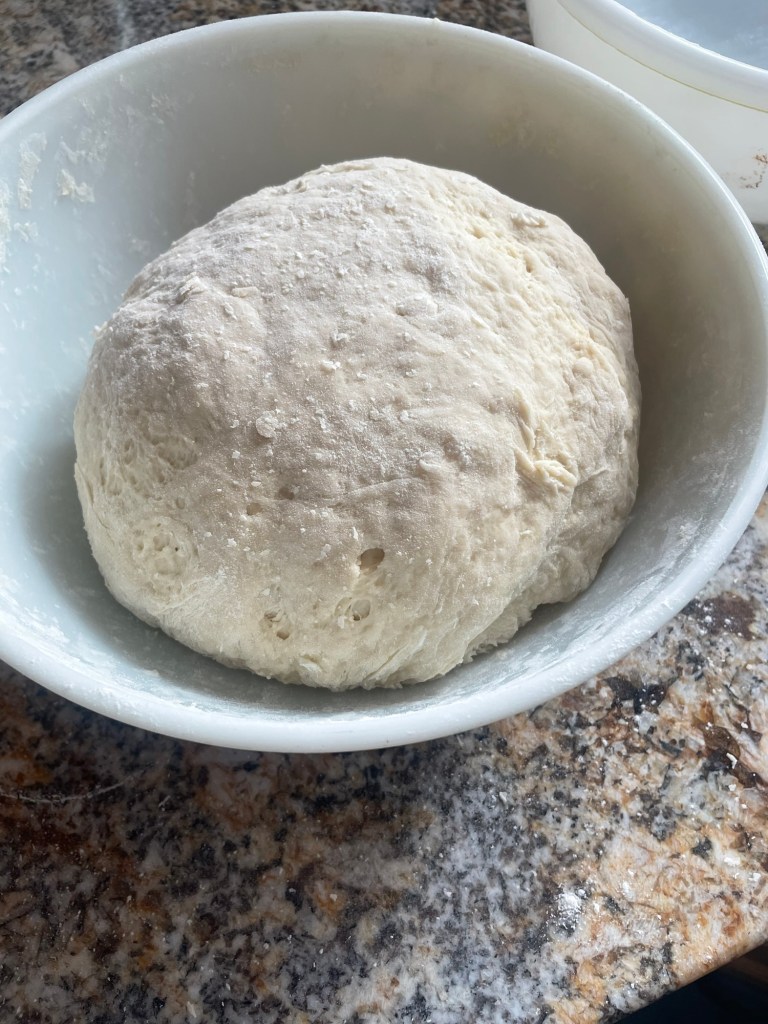
For me, holding bread can be as simple as things that remind me of moments of peace and joy – warm memories, thoughts of people I love, a glowing candle, kneading dough, playing piano, walking in fresh air, my dog. But Holding Bread is much more than that. Daily Bread. I have it and you have it and it’ll be there tomorrow.
 I am not in control.